
System resilience, avionics and graphical models
Null Hypothesis (H0): There is no published research that deals with the intersection of system resilience, avionics and graph models published on Science Direct.

The goal was to identify research published on Science Direct related to the constructs system resilience, avionics and graphical model. A system is resilient if it can maintain its desired operations under adverse conditions. Avionics is the subject matter that deals with the application of electronic technology in the field of aeronautics. A graphical model represents the probabilistic relationships among a set of variables. It combines probability theory and graph theory to represent uncertainty and relationships between input data and output variables.
Null Hypothesis (H0): There is no published research that deals with the intersection of system resilience, avionics and graph models published on Science Direct.
Alternative Hypothesis (Ha): Ha: There is published research that deals with the intersection of system resilience, avionics and graph models published on Science Direct.
The conclusion is presented first followed by the results. The next steps is then discussed followed by a discussion of the methodology for reproducibility.
Conclusion
Based on the methodology applied and the data collected, the Null Hypothesis can not be refuted. From the methodology used, there was no research identified that deals with the intersection of system resilience, avionics and graph models published on Science Direct.
Result
All published results including books where considered. 45 articles were considered for analysis. 36 article titles were rejected. The abstract of the 45 articles were analysed. A histogram with the published results are shown in Figure 1.
Figure 1: Histogram of published article date for the reviewed (Left) and rejected (Right) articles.
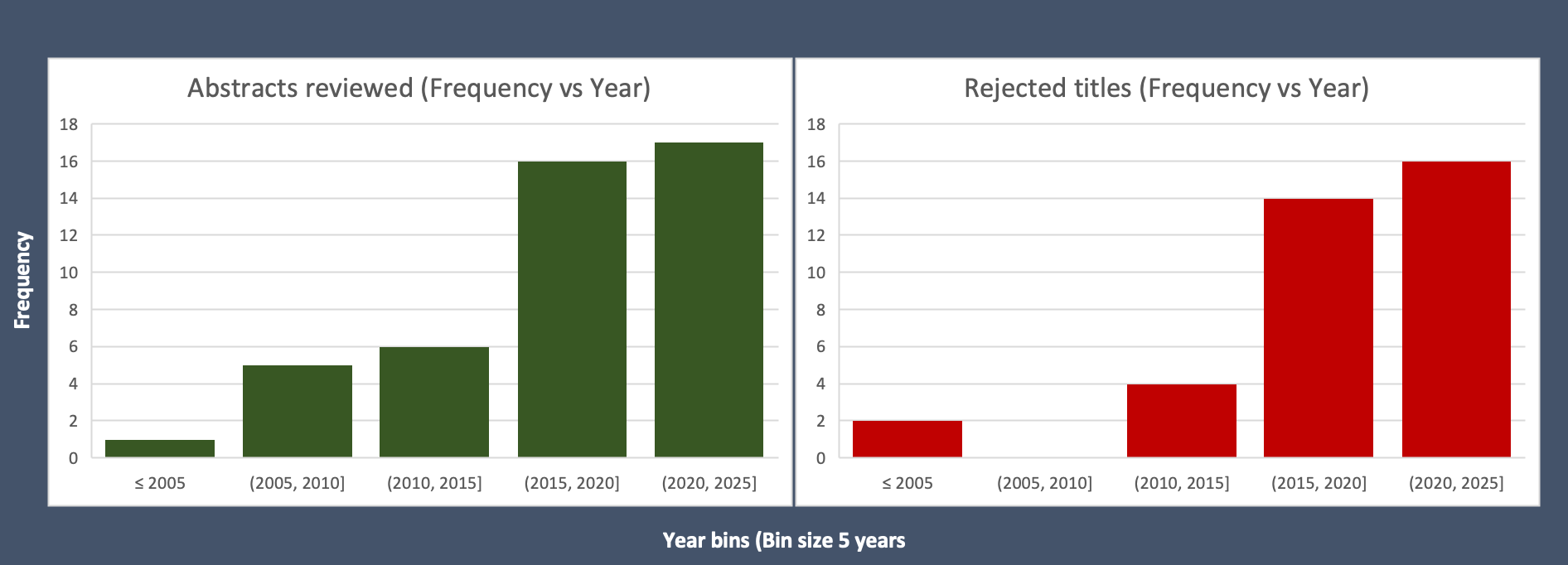
Of the 45 abstracts read, only 11 articles are classified as potentially relevant to the intersection of the three constructs. 8 articles are flagged as having potential tangential relation with the search terms. The remaining 26 is categorised as having no relevance to the constructs.
Of the 11 articles of interest. Articles 27, 29 and 36 discusses the use of model driven development with the objective of improving reliability. System healing or zero maintenance is discussed in 31, 36 and 38. Failsafe software design is discussed in 75. 73 discusses fault tree analysis and its use in complex system analysis. Unmanned or autonomous system integration into society is discussed in 33. Error sensitivity in Fast Fourier Transform architectures in 50. Cyber-physical systems are discussed in 36. Autonomous navigation techniques in 58. Article 40 discusses the techniques used in safety engineering and security engineering.
Unfortunately none of these abstracts create the impression that they will provide valuable insight in the use of graphical models in avionics systems with the objective of improving system resilience. Articles 27, 29 and 36 discuss methods to improve reliability of a system, reliability could be considered a measurable variables of resilience. Only 29 mentions the use of graphical models like Markov models. 27 focusses on the interfaces of IoT implementation and the importance of business logic and application abstraction where 36 discusses fault tolerance in cyber physical systems.
Methodology
Data was collected on Science Direct. The constructs system resilience, avionics and graphical model was used. System resilience, avionics and graphical model was used as the search terms. Searches were done under the topics Mathematics, Physics and Astronomy, Engineering and Computer Science. No results where available.
A general search with the search terms system resilience, avionics and graphical model was done. 81 articles where identified by the search. The title of the articles where reviewed for relevance relative to the construct definitions system resilience, avionics and graphical model.
Secondary interpretation of the constructs where used to broaden the review of an article title. For system resilience terms like safety, fault tolerance, systems, subsystems and components where considered. For avionics electronics, control, security, hardware, software and IoT was considered. For graphical models the terms models, probability, Markov, tree structures and Bayesian was considered.
Next steps
With the methodology used, the null hypothesis could not be refuted. Thus, there is no research published on Science Direct with the intersection of system resilience, avionics and graph models published on Science Direct. Due to the lack of intersection between the analysed abstracts and the constructs system resilience, avionics and graphical models. None of the articles was analysed further.
In order to expand the search the following steps could be considered:
Expand the search terms, introducing search groups. The search groups will have multiple search terms associated to a single construct. An example of this would be to search for specific graphical model names such as Probabilistic Graphical Models (PGM), Bayesian Networks (BN), Markov Random Fields (MRF), Factor Graphs (FG) etc. This can be expanded for all three constructs.
Expand the search into other journals such as IEEE, Nature, AIAA etc. By using the journal global rankings, focus can be placed on higher ranked journals in order to reduce the search space.
Data
Data is available as download from the link: 20240928_system_resilience__avionics__graphical_model_articles.
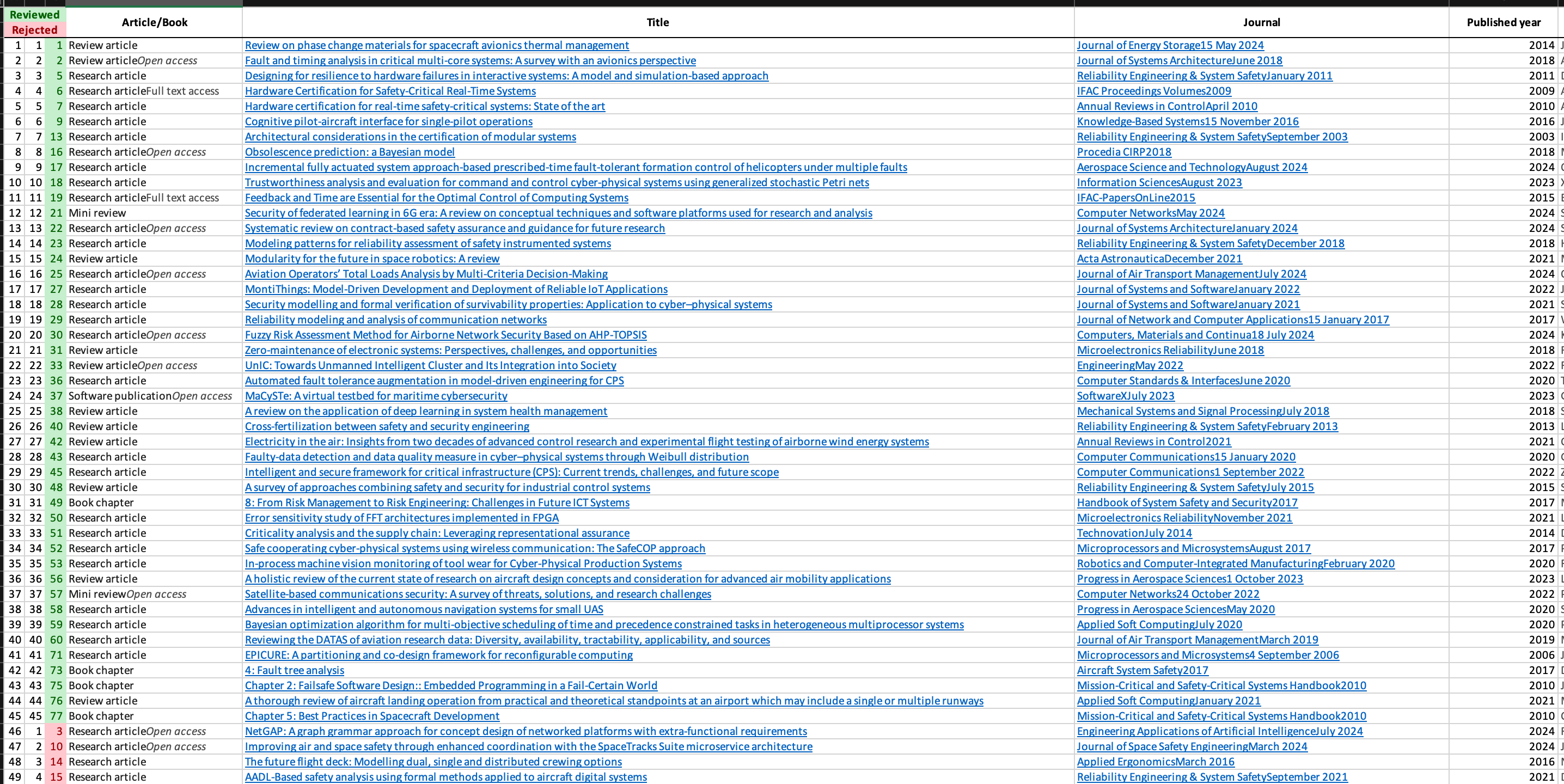
Three tabs are available. Raw list of articles tab is the raw data as downloaded from Science Direct. Reviewed list contains the articles after their titles where reviewed. Histogram tab contains the data for the frequency histogram. Sample data is presented below in Figure 2 for the Reviewed list tab.
Figure 2: Sample reviewed data.
How to refute a claim:
- https://pjconradie.substack.com/p/the-null-and-alternative-hypothesis